
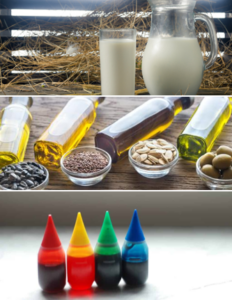
If you’ve spent more than five minutes on social media wellness posts, you’ve probably heard that seed oils are “toxic,” raw milk is a superfood, and artificial food dyes are the enemy.
Let’s take a deep breath and unpack what the science says — without the food shaming and dramatic background music.
🌻 Seed Oils: Villain or Victim?
Seed oils — like canola, soybean, sunflower, and peanut oil — have become public enemy #1 in certain wellness circles. The claim? They cause inflammation and chronic disease.
So, what’s really going on?
Here’s the nuance: Seed oils sometimes show up in studies linked to poor health outcomes. But that’s because they’re commonly found in fried foods and ultra-processed foods. If someone eats a diet heavy in “ultra-processed” and fast food it’s likely high in seed oils. But it’s also likely low in fiber, vitamins, minerals, and overall variety.
Blaming seed oils alone is like blaming the lettuce on a cheeseburger for heart disease.
In fact, when consumed in moderate amounts (about 2–3 tablespoons per day), seed oils fit perfectly well into a balanced eating pattern. Many contain unsaturated fats, which are beneficial for heart health.
✨ Takeaway: It’s not the seed oil in your stir-fry that’s the problem. It’s the overall dietary pattern that matters most.
🥛 Raw Milk: “Nature’s Perfect Food” or Risky Business?
Scroll social media and you’ll see influencers praising raw milk as more “natural” and more nutrient-dense than pasteurized milk.
Let’s clarify.
Pasteurization is simply heating milk to a specific temperature to kill harmful bacteria. It does not significantly reduce the nutritional value of milk. Protein, calcium, vitamins — they’re still there.
What does change? The risk of foodborne illness.
Data consistently show that you’re about 100 times more likely to get sick from raw milk compared to pasteurized milk. We’re talking bacteria like Listeria, Salmonella, and E. coli — illnesses that can be severe, especially for kids, older adults, pregnant individuals, and immunocompromised people.
And here’s the kicker: these illnesses are preventable through pasteurization.
✨ Takeaway: The nutritional “upgrade” is negligible. The safety downgrade is not.
🌈 Artificial Food Dyes: Are They Making Kids Hyper (or Worse)?
Artificial food dyes are having a moment in the rumor mill. Claims range from hyperactivity to cancer risk.
Here’s what the science says:
- Most concerning studies are conducted in animals, and animal data doesn’t automatically translate to humans.
- Some human studies suggest a possible link to hyperactivity in children — but the evidence is weak and difficult to tease out.
- Context matters. Are kids hyper because of Red Dye 40? Or because they’re at a birthday party with cake, friends, and excitement?
It’s surprisingly hard to separate food effects from environment, personality, sleep, and socioeconomic factors.
As for cancer risk? Current evidence does not support meaningful cancer risk at normal intake levels.
And here’s an important reality check: To approach potentially harmful levels of most food dyes, you’d need to consume hundreds of pounds of them in one sitting.
Replacing synthetic dyes with “natural” alternatives isn’t automatically better either. It can:
- Increase cost
- Shorten shelf life
- Change taste or texture
“Natural” doesn’t automatically mean safer or healthier.
✨ Takeaway: Panic isn’t supported by current evidence.
📏 What Are “Acceptable Daily Intake” (ADI) Levels Anyway?
This is where things get interesting.
Acceptable Daily Intake (ADI) levels are established by regulatory bodies like the World Health Organization and Health Canada.
ADI is defined as the amount of a substance that can be consumed daily for a lifetime without appreciable health risk.
And here’s the key: ADIs include large safety margins.
In other words, they’re conservative by design.
But let’s zoom out even further — anything can be harmful in excessive amounts. Water? Yes. Vitamins? Absolutely. Even oxygen can be toxic at extreme levels.
The existence of a safety threshold doesn’t mean something is dangerous. It means scientists have studied it carefully enough to determine what’s safe.
🎯 The Big Picture
Wellness trends often zoom in on one ingredient and treat it like the root of all evil. But health outcomes are rarely about one single food component.
If there’s one myth worth busting, it’s this: Health isn’t about eliminating one ingredient at a time. It’s about patterns, balance, and moderation. And maybe enjoying the cupcake at the birthday party, too. 🎂